
Yao Jianwei Wins the Athena Art Award for Art and Philosophy
 2026-08-16
From “Experiential Ink Imagery” to an Eastern Expression of Time and Being
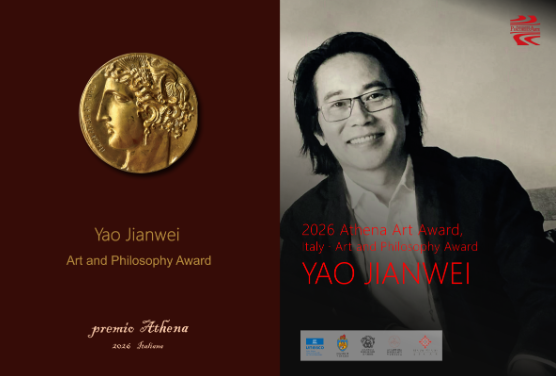
FLORENCE — The winners of the 2026 Athena Art Award in Italy were recently announced, with Chinese artist Yao Jianwei receiving the Award for Art and Philosophy. The recognition not only acknowledges his artistic practice, but also brings his evolving concept of “Experiential Ink Imagery” into a broader international art context. Particularly noteworthy is that Yao has not confined the contemporary transformation of ink art to formal innovation. Instead, his practice has increasingly turned toward deeper questions of time, life, memory, and being, transforming ink into a field in which personal experience and philosophical reflection converge.
In Yao Jianwei’s recent work, narrative landscape and recognizable objects have gradually receded. In their place, the spreading, layering, rupturing, and sedimentation of water and ink on xuan paper have become central to the work itself. Ink is no longer merely a medium for depicting an object; it becomes an event in the process of occurring. Painting, accordingly, shifts from the production of a predetermined image toward an experience of the image as it comes into being.
This is precisely the significance of “experience” within Experiential Ink Imagery. It is neither a subject matter nor a conceptual label imposed upon the work, but a method of creation and existence: bodily movement, material response, the passage of time, the awakening of memory, artistic judgment, and unpredictable chance all participate in the formation of the image. Yao’s question is therefore no longer simply how ink can be used, but rather: before an image is named, how does it emerge from human experience, time, and material?
The representative Time Series brings this inquiry into particularly sharp focus.
For Yao, time signifies both transience and a form of continuity that extends beyond individual life. It encompasses change and growth while also constituting one of the fundamental dimensions through which we understand our own existence. Human beings cannot exist outside time: memory, experience, choice, and even our understanding of the world are continuously formed within it. The Time Series, therefore, is not simply a poetic representation of “the passage of years.” Rather, it attempts to transform time into a pictorial structure that can be seen and experienced. Time is no longer merely the subject represented by the work; it becomes a mechanism through which the work itself is generated.
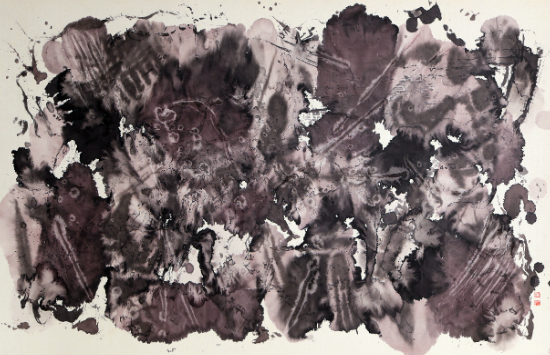
Yao Jianwei, Time, ink on paper, 73 × 110 cm, 2025
The blurred, overlapping, and at times almost unnameable fields of color in the Time Series consequently acquire a significance that extends beyond form itself. The ambiguity of color becomes a kind of perceptual measure of the duration of life. Layers cover, penetrate, recede, and re-emerge, corresponding to processes of growth, memory, and psychological experience. Life is not composed of isolated moments; it acquires depth and breadth through the continuous accumulation, superimposition, and revision of time. It is within this process of constant change that the individual experiences the self, encounters the world, and gradually develops an understanding of being.
The horizontally unfolding, calligraphic brushwork introduces another temporal rhythm into the paintings. The vitality, gestural qualities, and temporal consciousness of Eastern ink painting encounter the movement, contingency, and visual tension associated with modern abstraction. Yao does not simply juxtapose Eastern and Western forms; rather, he searches between these two visual traditions for a mode of perception that belongs to contemporary experience.
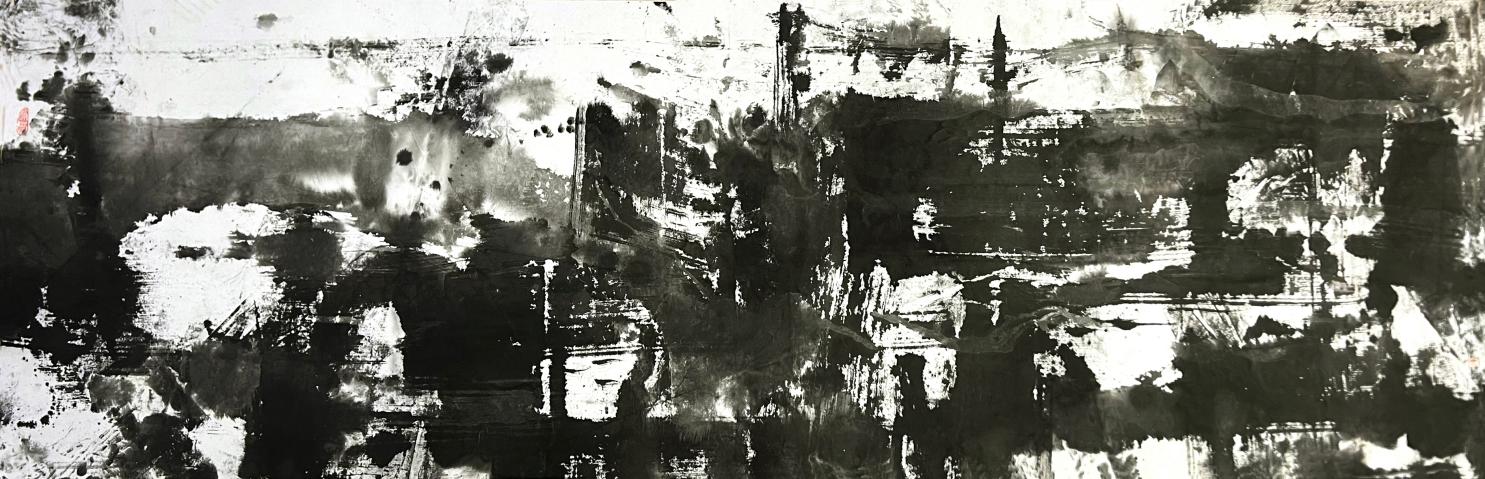
Yao Jianwei, Time, ink on paper, 58 × 177 cm, 2023
Human memory is never preserved as a complete chronological sequence. More often, it is suddenly awakened by a familiar sensation: the past re-enters the present, and emotions and experiences once concealed rise again to the surface. The traces that are repeatedly covered and revealed in the Time Series possess precisely this psychological quality. Some things have disappeared without ever truly leaving; certain experiences may have been covered by subsequent layers of time, yet they continue, at a deeper level, to shape who we are today.
The time addressed in these works therefore moves beyond chronological time into psychological and lived time. Their layered transformations evoke both the ceaseless changes of the world and the question of how an individual maintains a sense of continuity within that change. Against the irreversible current of time, the individual may appear insignificant, yet human choices, actions, and memories continually endow finite life with meaning. Even if time appears to unfold in endless cycles, life is never merely repetitive, because every choice alters the structure of experience.
It is precisely here that Yao Jianwei’s Experiential Ink Imagery begins to move beyond the conventional discussion of the modernization of ink painting.
The artist does not work within a digital interface where every decision can be endlessly undone. He confronts instead a material process unfolding irreversibly through time—one in which every action requires judgment and every decision leaves a consequence.
Experiential Ink Imagery, therefore, does not use a traditional medium as a form of resistance to technology. Rather, within an increasingly technological civilization, it seeks to reaffirm the significance of the human body, time, memory, and lived experience. As machines become increasingly capable of producing images, art may need to ask an even more fundamental question:
Beyond the image, what has the human being actually experienced?
Yao Jianwei’s receipt of the 2026 Athena Art Award in Italy — Award for Art and Philosophy provides a new international point of reference from which to consider his practice. Yet more significant than the award itself is whether he can continue to develop Experiential Ink Imagery beyond a distinctive language of contemporary ink painting and establish it as a more comprehensive artistic methodology concerned with time, life, memory, and being.
In this sense, Yao Jianwei’s Time Series does not depict time that has already passed. It allows time to participate in the act of painting, enables memory to occur again, and gives lived experience a perceptible form through the unfolding interaction of water, ink, and color.
Ink, therefore, is no longer merely a medium through which the world is represented. It becomes a way for human beings to understand themselves, perceive the world, and question the nature of existence within time.
By Adam Blake